Our pick
Russell Hobbs BRITA Purity glass kettle (1.5L)
Why we picked it
- Filters water as you fill, so less scale reaches the element
- Glass body shows build-up before it gets bad
- Comes with a BRITA cartridge to start
Worth knowing
- Cartridges are an ongoing cost
- You’ll still want to descale now and then in very hard water
Paid link
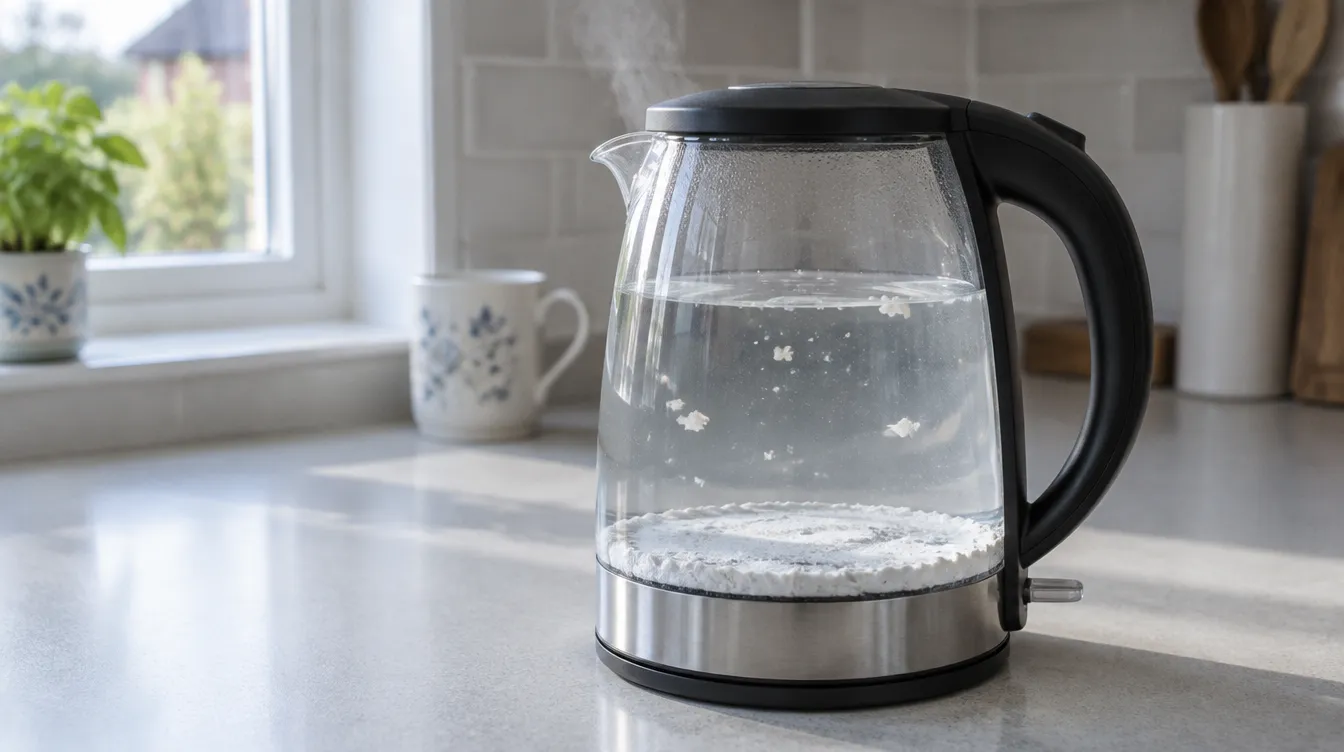
You pour the tea and a few chalky flakes drift to the top. Look inside the kettle and the base has a white crust on it. You descaled it last month, and somehow it’s back already.
If you live in much of southern or eastern England, that’s simply what your water does. The good news is that it’s harmless to drink, and keeping on top of it takes about ten minutes every few weeks.
What you’re looking at
Hard water carries dissolved calcium and magnesium, picked up as it passes through chalk and limestone. Heat it and some of the calcium drops out as calcium carbonate. That’s limescale. A kettle boils several times a day, so it collects more than almost anything else in the house.
The flakes won’t hurt you. The cost is efficiency: scale forms an insulating crust over the element, so the kettle takes longer to boil and works harder each time. It can also leave tea tasting flat.
Is your area hard?
The Drinking Water Inspectorate publishes a map of typical hardness across England and Wales, but it notes that local supplies vary. For an exact figure, check your water company’s website. Most have a postcode lookup that takes a few seconds.
As a rough guide, much of the south and east of England has hard or very hard water, while Wales, Devon, Cornwall and the north-west of England are generally softer. Postcodes vary within those areas, so the lookup on your supplier’s website is the reliable answer.
How to descale a kettle properly
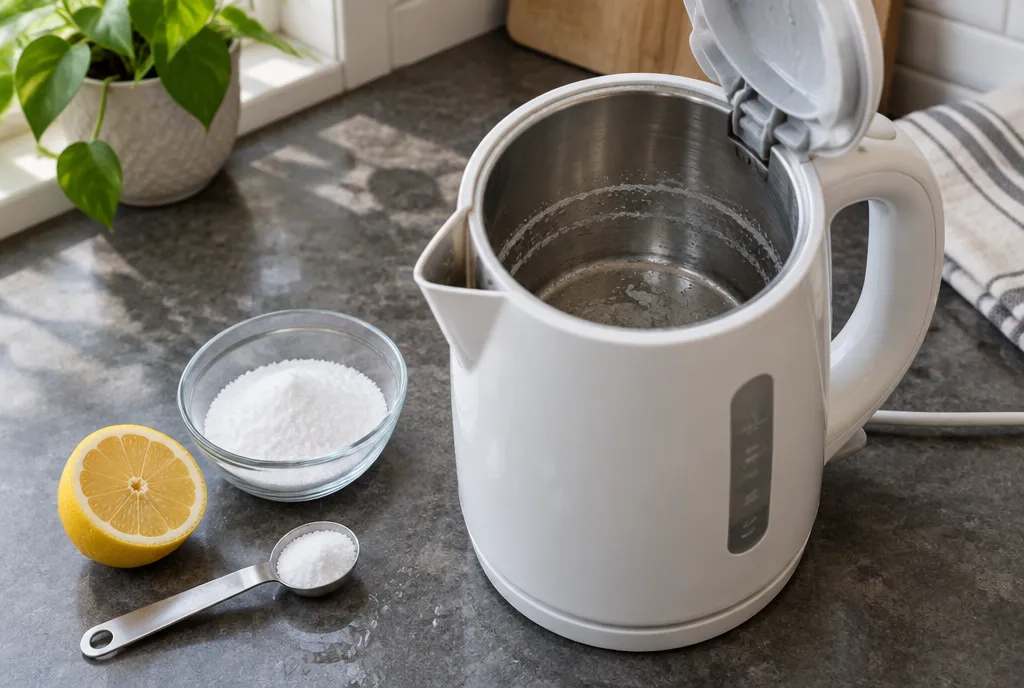
- Half-fill the kettle with water.
- Add citric acid (follow the packet) or a similar amount of white vinegar to water, roughly half and half.
- Bring it to the boil, switch off and leave it to stand for about an hour.
- Pour it away and loosen any stubborn patches with a soft brush. Nothing abrasive.
- Rinse well, then boil a full kettle of fresh water and throw it away to clear any taste.
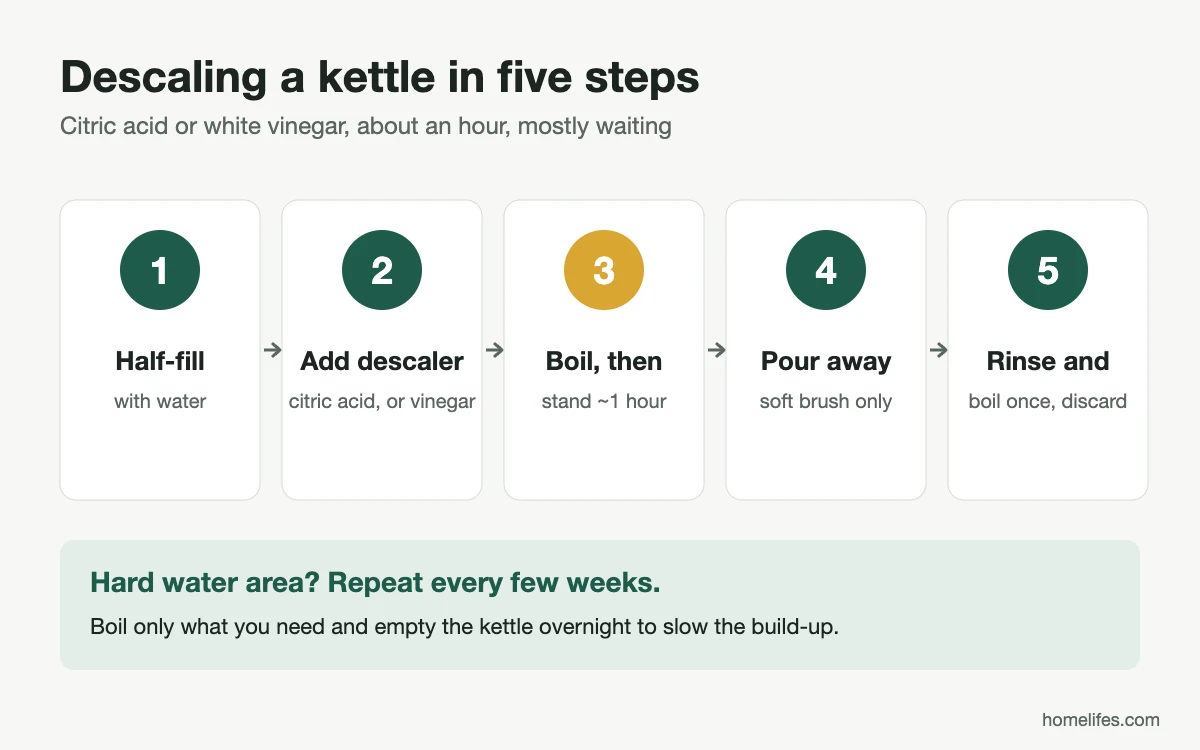
Vinegar works, but it smells. Citric acid does the same job without making the kitchen smell like a chip shop.
Keeping it away for longer
- Boil only the water you need. Less water heated means less scale left behind.
- Empty the kettle rather than leaving water sitting in it overnight.
- Wipe the base dry now and then. Scale grips more easily onto an old layer.
Kettle filter or water softener?
A filter jug or filter kettle treats only the water you drink and boil, which is cheap and simple. A whole-house water softener protects every appliance and pipe, but it’s a bigger installation, and according to the Drinking Water Inspectorate most softeners work by swapping the hardness for sodium. That’s why many homes keep one unsoftened tap for drinking water.
If the kettle and the coffee machine are your only real problem, a filter is the proportionate fix. If you’re also fighting scale on taps, showers and the washing machine, a softener is worth a quote.
When it’s time for a new kettle
- It still takes noticeably longer to boil after a thorough descale.
- The base or element is pitted, rusty or flaking under the scale.
- It leaks, or the lid and switch no longer close or turn off reliably.
- The glass is cracked, or the cable or plug is damaged. Stop using it straight away.
What’s actually worth buying
You don’t need much. It depends on whether you want to fix the kettle you’ve got, or deal with the water before it gets there.
For the kettle
New kettle
Russell Hobbs BRITA Purity glass kettle (1.5L)
What it does: filters the water through a BRITA cartridge as you fill it, so less scale reaches the kettle in the first place. A cartridge comes in the box.
Watch out for: the running cost. Cartridges need replacing regularly.
Paid link
Keep your kettle
Chef Aid stainless steel kettle descaler (4 pack)
What it does: a stainless steel ring that sits inside the kettle. Scale tends to collect on it instead of the base, and you rinse the ring rather than the kettle.
Watch out for: narrow kettle openings. Check it will fit.
Paid link
Deep clean
Kilrock Mega-K descaler (1L)
What it does: a well-known UK descaler for when the base needs a proper reset. One bottle covers a dozen doses.
Watch out for: doubling up. If you already keep citric acid, you may not need it.
Paid link
For the water
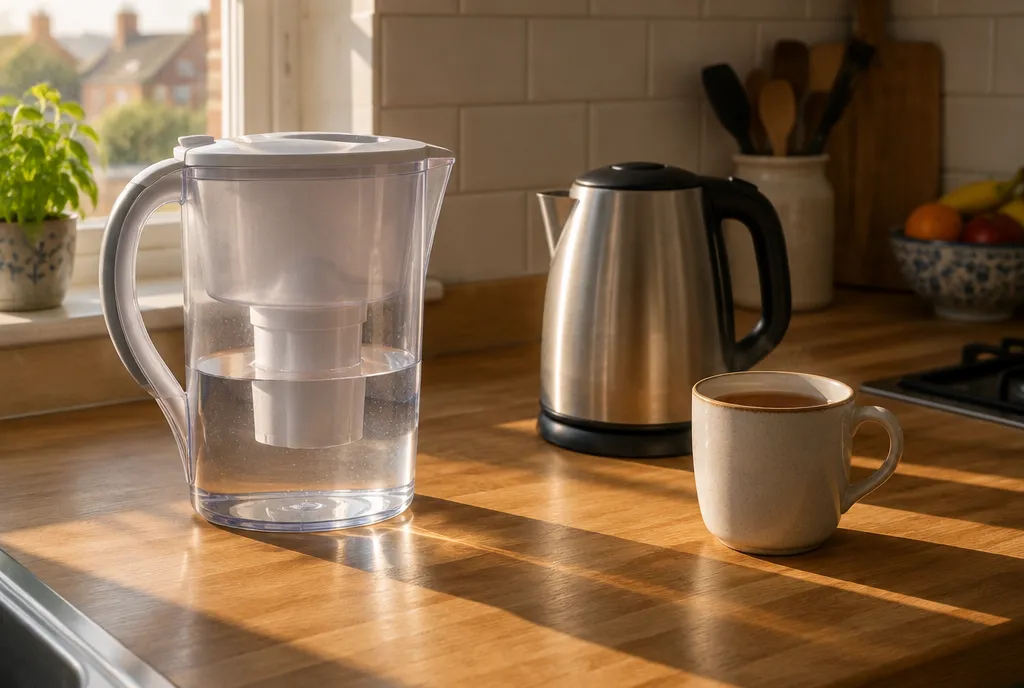
Filter jug
BRITA Marella filter jug with 3 cartridges
What it does: filters water before it reaches the kettle, which helps the coffee machine and the iron as well.
Watch out for: fridge space. A full jug takes up a shelf.
Paid link
Refills
BRITA MAXTRA PRO cartridges (6 pack)
What it does: brings the cost per cartridge down, which makes it more likely you’ll actually change them on time.
Watch out for: buying in bulk before you know the jug habit sticks.
Paid link
Quick answers
Is limescale in tea bad for you?
No. It’s mostly calcium carbonate. It’s a nuisance and an efficiency problem rather than a health one.
Does a water softener fix it?
A whole-house softener reduces scale, but many homes keep one unsoftened tap for drinking water. Check how yours is plumbed before relying on it for the kettle.
Weighing up a new appliance as well? See when an air fryer actually beats the oven.