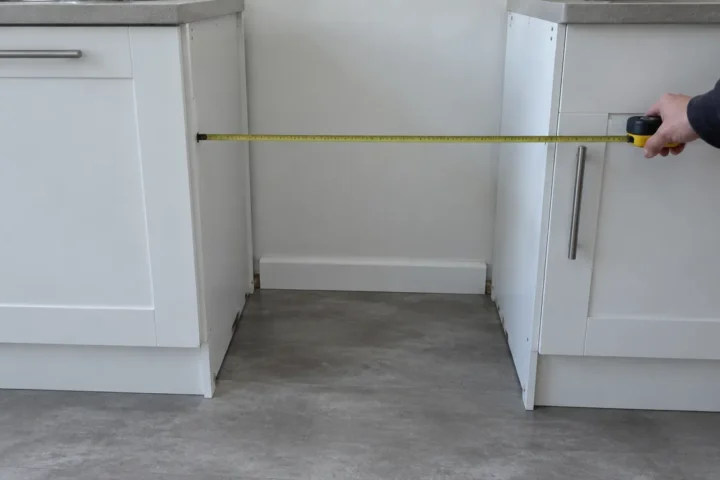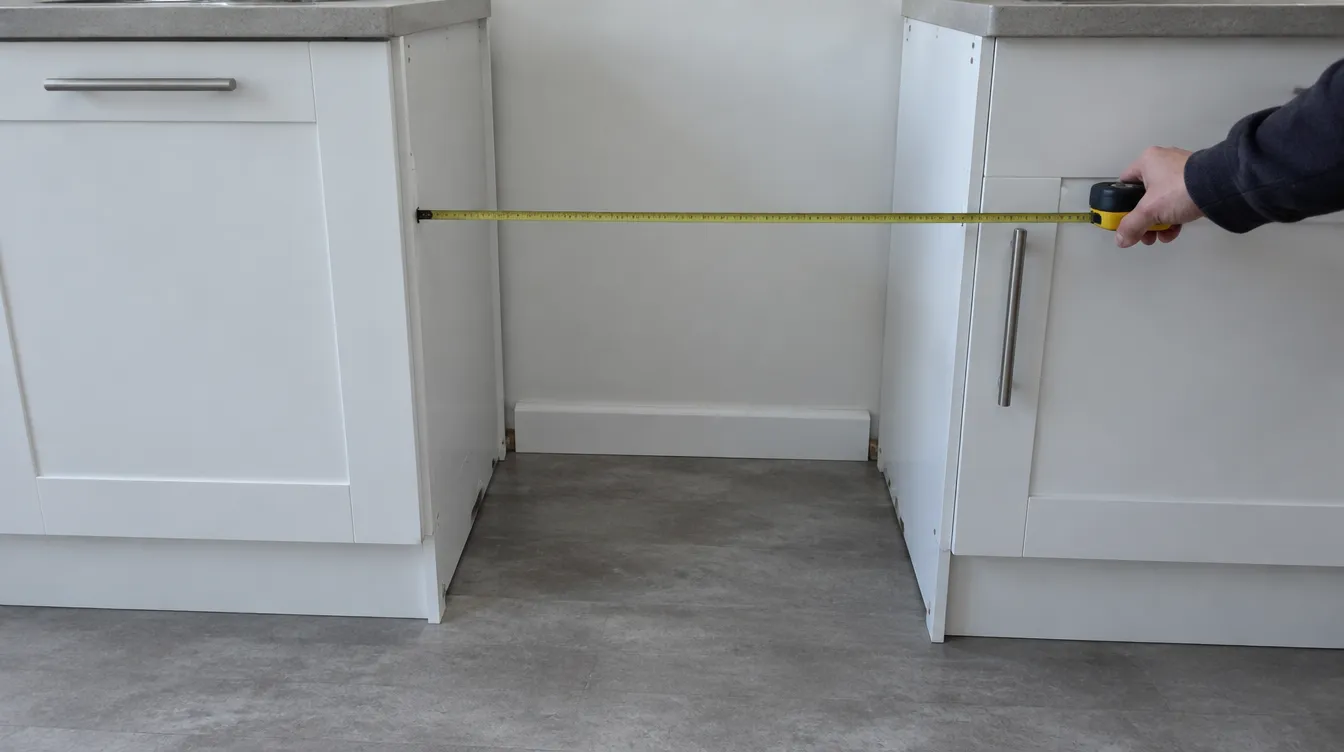
Our pick
Stanley Tylon 5m tape measure
Why we picked it
- Long enough to measure a run of units and the doorway
- A locking blade holds the reading while you write it down
- Plain and reliable, which is all this job needs
Worth knowing
- Measure twice and write the numbers down
- Hold the tape flat and straight, or the reading is out
Paid link
The most expensive appliance mistake isn’t buying the wrong model. It’s buying the right model in the wrong size, then finding out when the delivery team is in your kitchen. A dishwasher that won’t slide under the worktop is a very bad afternoon.
The good news is that UK kitchens are built around a few standard sizes. This is the cheat sheet, plus what to measure before you click Buy.
The standards, in one place
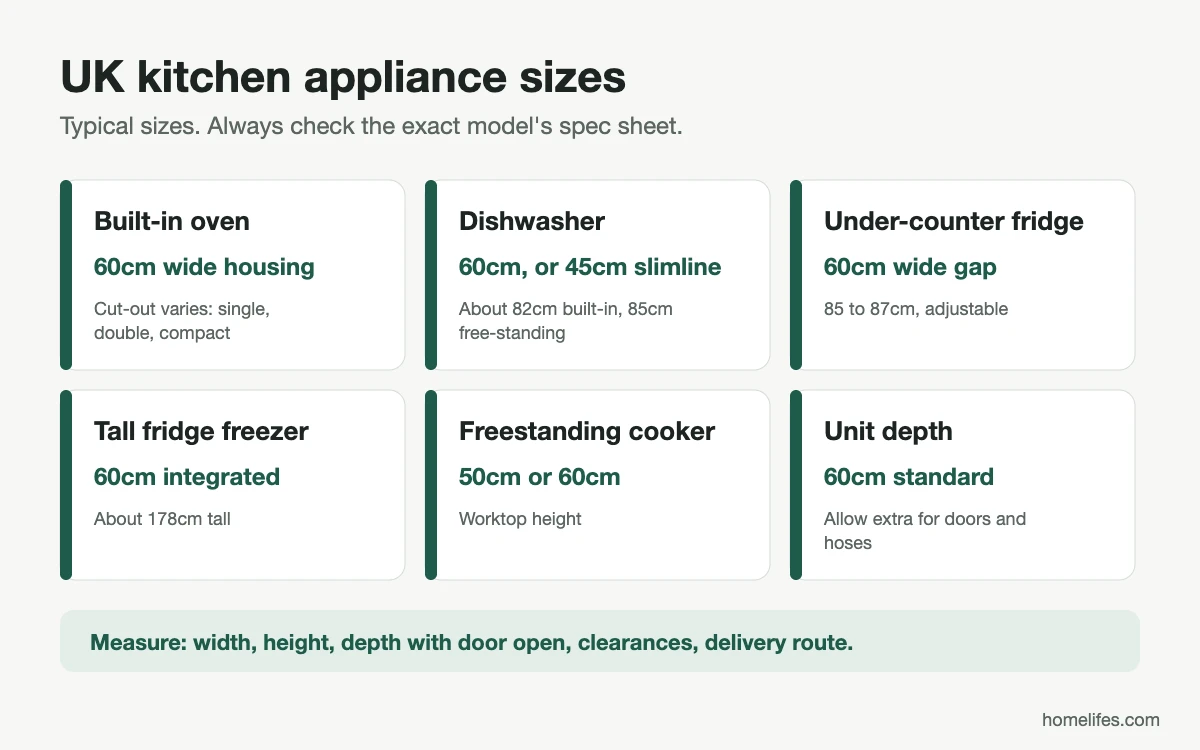
The UK Metric Association notes that the standard kitchen unit depth is 60cm, and that cabinets for built-in appliances such as ovens, fridges and microwaves are 60cm wide. Most standalone appliances are 60cm wide, some cookers come at 50cm, and dishwashers are usually 60cm with a 45cm slimline option.
| Appliance | Typical width | Typical height | Worth knowing |
|---|---|---|---|
| Built-in oven | 60cm housing | Varies. Single, double and compact differ | Check the exact model’s cut-out size |
| Full-size dishwasher | 60cm | About 82cm built-in, 85cm freestanding | Around 60cm deep. One maker advises leaving about a metre in front to open the door |
| Slimline dishwasher | 45cm | Around 82cm | One retailer’s example is 818 × 446 × 550mm (height × width × depth) |
| Under-counter fridge or freezer | 60cm | 85 to 87cm, adjustable | The KBSA says built-under units sit on the floor and slot into a 60cm gap |
| Tall fridge freezer | 60cm (integrated) | About 178cm | Freestanding sizes vary far more |
| Freestanding cooker | 50 or 60cm | Worktop height | Range cookers are much wider |
Sources for the figures: KBSA for refrigeration, DIY Kitchens for dishwasher examples, and LG for dishwasher height and door clearance. Treat them as typical, and always check the spec sheet of the exact model.
Does it need a unit, or just a door?
Integrated appliances differ in what they need around them. DIY Kitchens’ guide sets it out simply:
| Appliance | What it needs |
|---|---|
| Tall fridge freezer | A kitchen unit |
| Integrated oven | A kitchen unit |
| Fitted microwave | A kitchen unit |
| Half-size fridge or freezer | Just a door |
| Dishwasher | Just a door |
| Washing machine | Just a door |
Integrated, semi-integrated or freestanding?
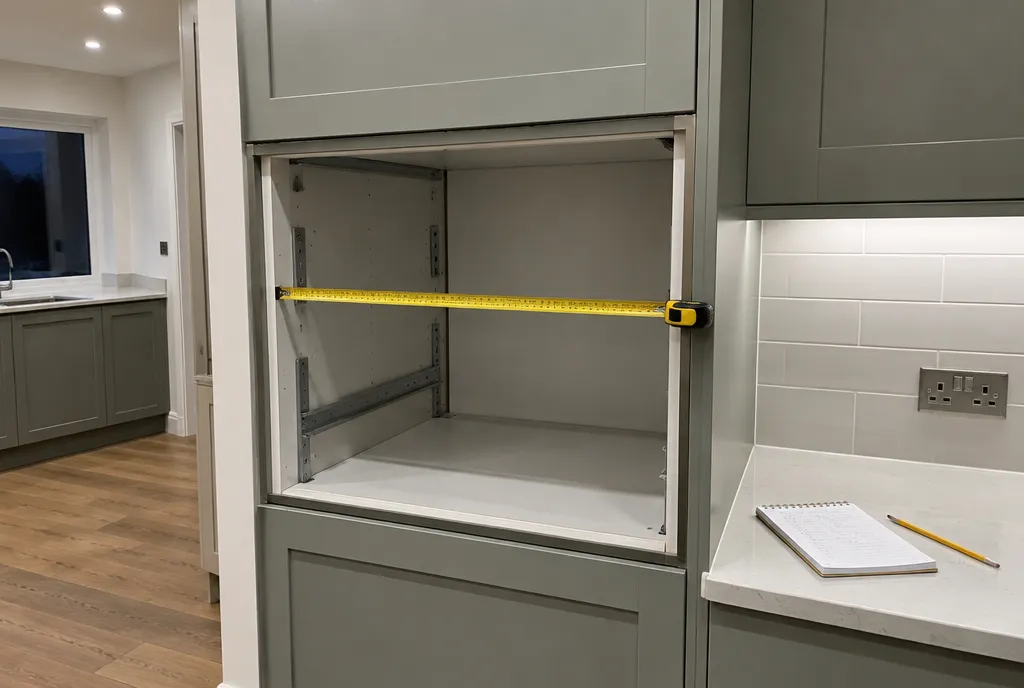
The KBSA describes the difference: a built-in appliance has a kitchen door fitted to the front so it disappears into the units, a semi-integrated one has a décor panel attached to the front, and a freestanding one stands on its own. That choice changes which measurements matter. For an integrated model, it’s the unit opening and the door that has to match, and for a freestanding one, it’s the gap and the clearances around it.
What to measure before you buy
- Width of the gap, at the top, middle and bottom. Walls and units aren’t always straight.
- Height, from the floor to the underside of the worktop. Remember the floor may not be level, and feet are adjustable.
- Depth, including the handle, the door when open, and room behind for pipes and cables.
- Clearance for the door to open fully, and for any other appliance or drawer next to it.
- Ventilation and installation gaps, which the manufacturer’s manual specifies.
- The delivery route: doorways, stairs, corners and the lift.
- Outlets: where the socket, water supply and waste are, and whether the appliance’s cables and hoses reach.
Write the measurements down and compare each one with the manufacturer’s installation diagram for the model, not just the headline width and height.
A worked example: replacing a dishwasher
- Measure the width, height and depth of the existing gap, and note whether it’s 60cm or 45cm.
- Find the installation guide for your shortlisted models and check each against your three measurements.
- Check the hose and cable routes, and where the socket and water supply are.
- Check the door has room to open fully, and that nothing else, such as a drawer or the oven door, will clash with it.
- If it’s integrated, check whether your existing door will fit or you need a new one.
- Confirm the delivery route before you book.
Small kitchens and countertop appliances
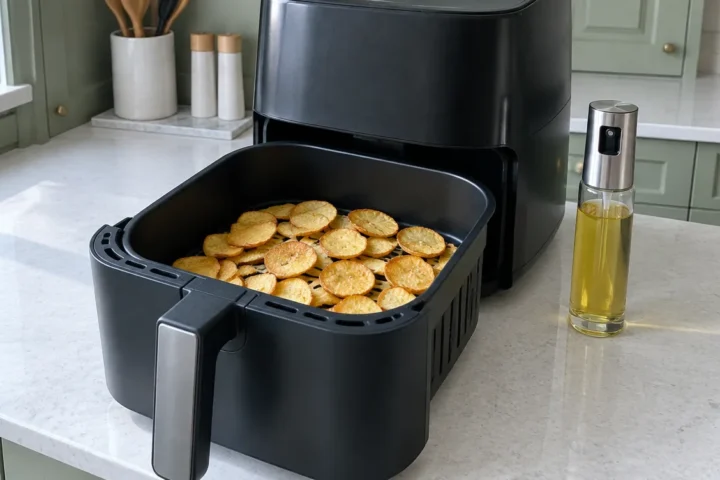
Slimline dishwashers and compact ovens exist for tight spaces. For countertop appliances like air fryers, measure the worktop, the clearance under wall cupboards (steam and heat need somewhere to go), and the space to pull a drawer fully out. Our guide to single basket and dual drawer air fryers covers sizing the layout to your worktop.
Tools worth having
A second opinion
Bosch EasyDistance 20 laser measure
Good for: measuring a wall-to-wall gap or a long run in one go, and checking diagonals.
Not ideal if: you only measure the occasional gap. A tape does the job.
Paid link
Appliance sizes: common questions
Are all kitchen units 60cm?
Depth is almost always 60cm, and most widths are multiples of 5cm. The widths that matter for appliances are usually 45cm and 60cm.
Do I need a gap around an integrated dishwasher?
Yes, for the door, hoses and ventilation. The manufacturer’s installation guide for your model gives the exact clearances.