Our pick
Tapo P110 smart plug with energy monitoring (2 pack)
Why we picked it
- Shows how much power an appliance draws, so you can stop guessing
- Rated for up to 13A, which covers a 3kW kettle
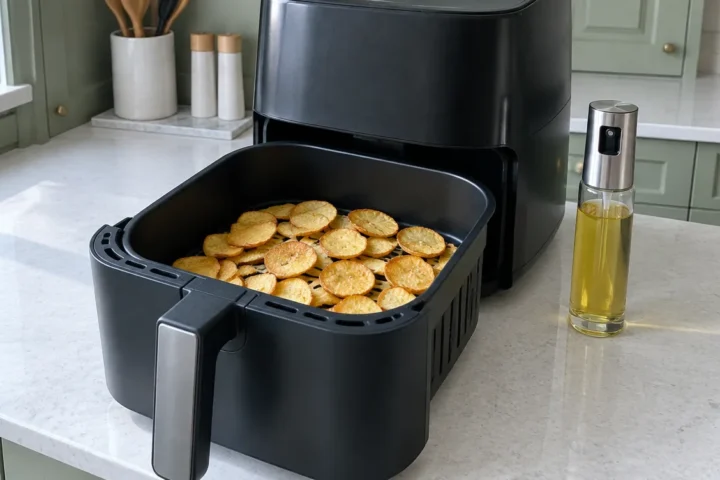
- Two in the pack, so you can check the toaster or air fryer as well
Worth knowing
- It needs the Tapo app and Wi-Fi to show readings
- Check the listing for the exact rating and compatibility before you buy
Paid link
The kettle is the appliance people feel guilty about. It’s high-powered, it’s on every day, and it’s easy to picture the electricity meter spinning. The reality is less dramatic: a boil costs pence. What matters is how many pence, how often, and how much water you boil that you never use.
The formula
Everything comes from two lines:
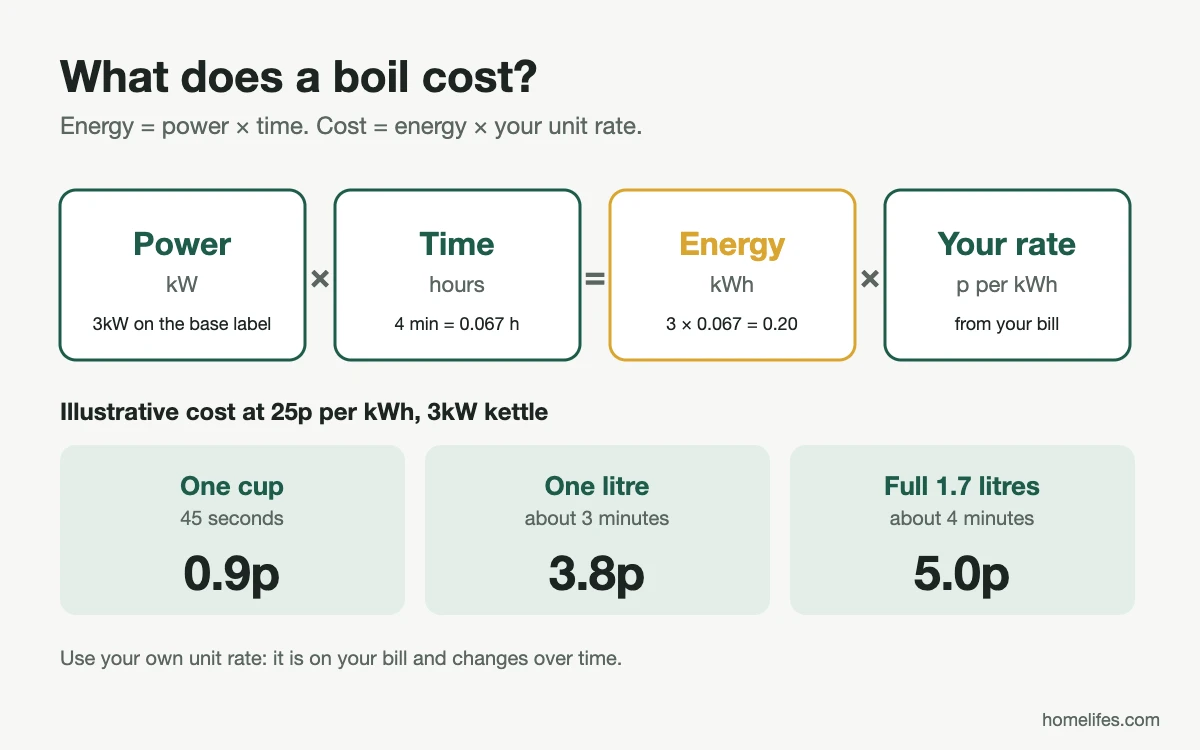
- Energy (kWh) = power (kW) × time (hours)
- Cost = energy (kWh) × your unit rate (pence per kWh)
Your kettle’s power is printed on the base or the label, usually 2 to 3kW (2,000 to 3,000W). Your unit rate is on your bill or in your supplier’s app. Rates change, and the price cap is reviewed regularly, so use your own figure and treat the examples below as illustrations, not today’s prices.
What a boil costs at three rates
These figures use a 3kW kettle and typical boil times quoted by UK consumer sites such as Ideal Home: about 45 seconds for a cup, around 4 minutes for a full 1.7 litres. Sources put one litre at 2 to 3 minutes, and I’ve used 3, so the table errs on the high side. Your kettle will differ.
| How much you boil | Energy | At 20p/kWh | At 25p/kWh | At 30p/kWh |
|---|---|---|---|---|
| One cup (about 235ml), 45 seconds | 0.04 kWh | 0.8p | 0.9p | 1.1p |
| One litre, about 3 minutes | 0.15 kWh | 3.0p | 3.8p | 4.5p |
| Full 1.7 litres, about 4 minutes | 0.20 kWh | 4.0p | 5.0p | 6.0p |
Where the money actually goes
A single boil is trivial. The cost is the habit. Take five hot drinks a day, every day of the year:
| Five drinks a day | Energy a year | At 20p | At 25p | At 30p |
|---|---|---|---|---|
| Fill the kettle (1.7L) every time | 365 kWh | £73.00 | £91.25 | £109.50 |
| Boil just a cup’s worth each time | 68 kWh | £13.69 | £17.11 | £20.53 |
| Difference | £59.31 | £74.14 | £88.97 |
Boiling only what you need is the biggest saving, and it’s free. Use the water gauge, and if your kettle only has a litre scale, fill to the level of your mug. Some kettles also have a minimum fill that makes a single cup wasteful, which is worth checking before you buy.
Does a higher wattage cost more?
Not necessarily. As Ideal Home notes, a lower-powered kettle takes longer to boil the same water, so it runs for longer. What costs you is how much water you heat and how efficiently the kettle works, not just the number on the label.
Where a kettle sits among kitchen appliances
| Appliance | Typical rated power | Time | Energy at full power |
|---|---|---|---|
| Kettle, full boil | 3kW | 4 minutes | 0.20 kWh |
| Air fryer | 1.5kW | 20 minutes | 0.50 kWh |
| Electric oven | 2.5kW | 30 minutes | 1.25 kWh |
Air fryers and ovens switch their elements on and off once they’re hot, so their real use is lower than the table. A kettle runs flat out for its short boil. A single boil is small, but it happens many times a day, which is why the habit matters more than the appliance.
Quick wins, ranked
| Habit | Effort | Effect |
|---|---|---|
| Boil only what you need | None | The biggest saving |
| Descale when scale builds up | About ten minutes every few weeks | Keeps boil times down |
| Use the kettle, not the hob, to boil water for cooking | None | Recommended by the Energy Saving Trust |
| Pick a kettle with clear cup and litre markings | At purchase | Makes it easier to measure what you need |
Limescale quietly makes it worse
In a hard water area, scale on the element slows the boil and wastes energy. Descaling regularly keeps the kettle working as it should. Our guide to descaling a kettle and keeping limescale away covers how.
Kettle, hob or microwave?
For boiling water for cooking, the Energy Saving Trust recommends the kettle rather than the hob, as reported by Homebuilding. An energy expert quoted by Ideal Home says a microwave can be marginally cheaper but needs careful timing, so it isn’t the best method. For almost everyone, the kettle is the simple, safe answer.
Measure your own
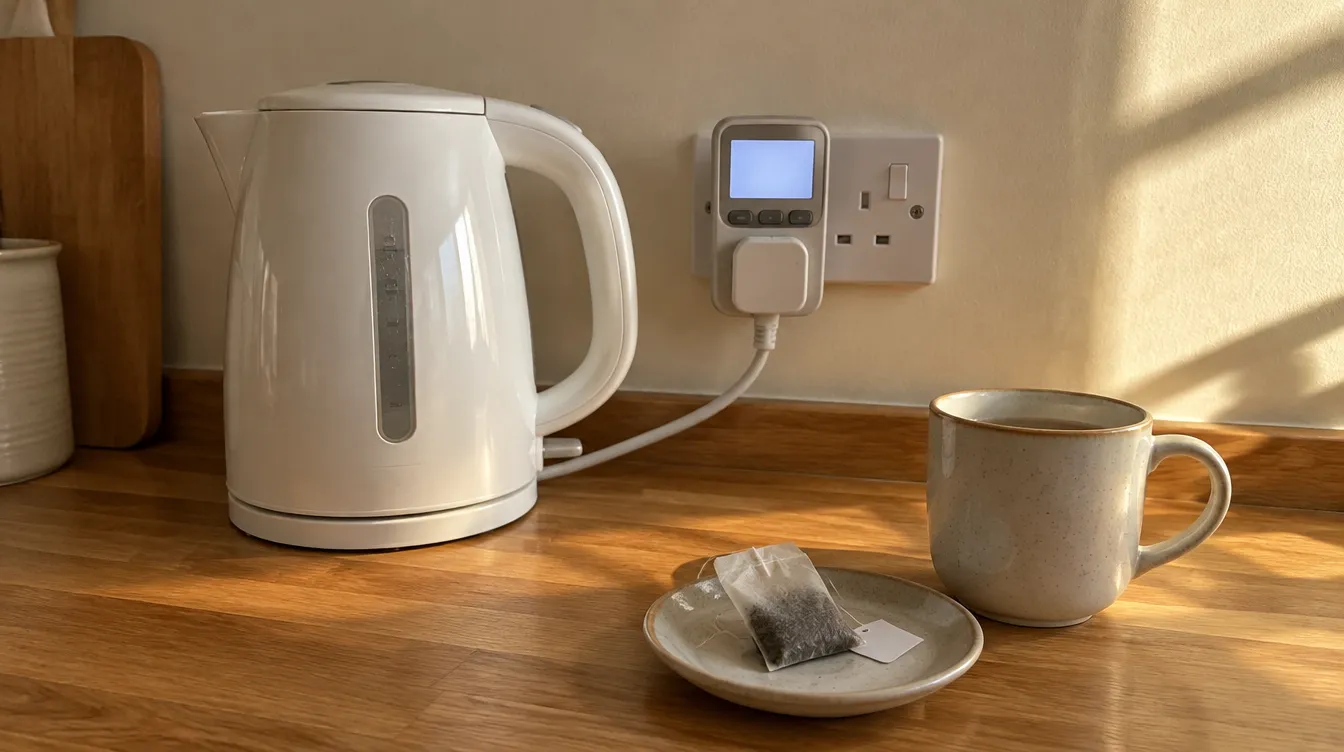
- Plug a monitoring plug into the wall and the kettle into the plug.
- Boil one cup, one litre and a full kettle, noting the energy used each time.
- Multiply each figure by your unit rate to see what you actually pay.
A plug-in monitor also works on a toaster, an air fryer or a slow cooker, so it’s useful beyond this one test. Our guide to air fryer vs oven running costs uses the same sum.
Worth having
Keep it scale-free
Kilrock Mega-K kettle descaler (1L)
Good for: resetting a kettle that has built up scale, so it boils at its best.
Not ideal if: you already descale with citric acid or vinegar.
Paid link
If you’re replacing it
Russell Hobbs BRITA Purity glass kettle (1.5L)
Good for: filtering the water as you fill, so less scale reaches the element.
Not ideal if: you don’t want the running cost of replacement cartridges.
Paid link
Kettle costs: common questions
Does a kettle use a lot of electricity?
It uses a lot of power for a short time. A 3kW kettle draws 3kW while it boils, but a boil takes only a few minutes, so a single boil uses a small amount of energy.
Is it cheaper to reboil water?
You pay for every boil, so reheating water you’ve already boiled costs energy again. Boiling only what you’ll use is cheaper than boiling extra.