Our pick
Victorinox Swiss Classic chef’s knife (18cm)
Why we picked it
- The curved blade lets you rock through herbs and garlic and chop quickly
- Light and easy to control, with a grippy handle
- Affordable enough to replace rather than baby
Worth knowing
- Rocking takes a little practice if you’re used to chopping straight down
- If your board is small, a shorter, flatter knife may feel easier
Paid link
Walk into any kitchen shop and the two knives sit side by side: a chef’s knife and a santoku. They’re a similar length, they look similar, and the labels promise roughly the same thing. So which one actually suits you?
The answer comes down to one thing: how you naturally chop.
The real difference is the shape of the blade
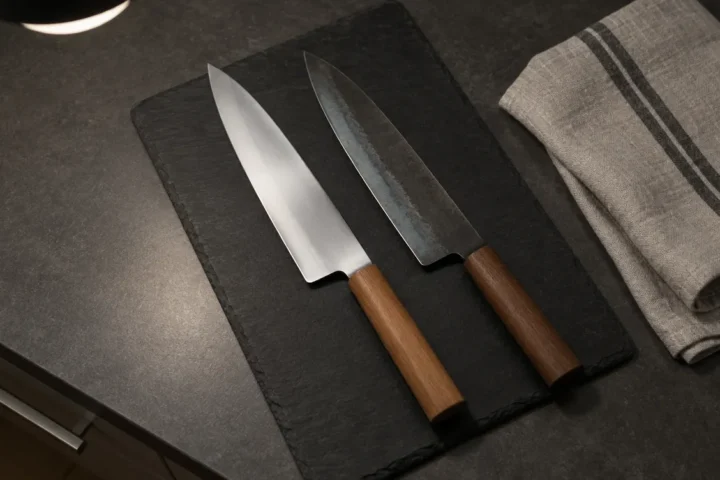
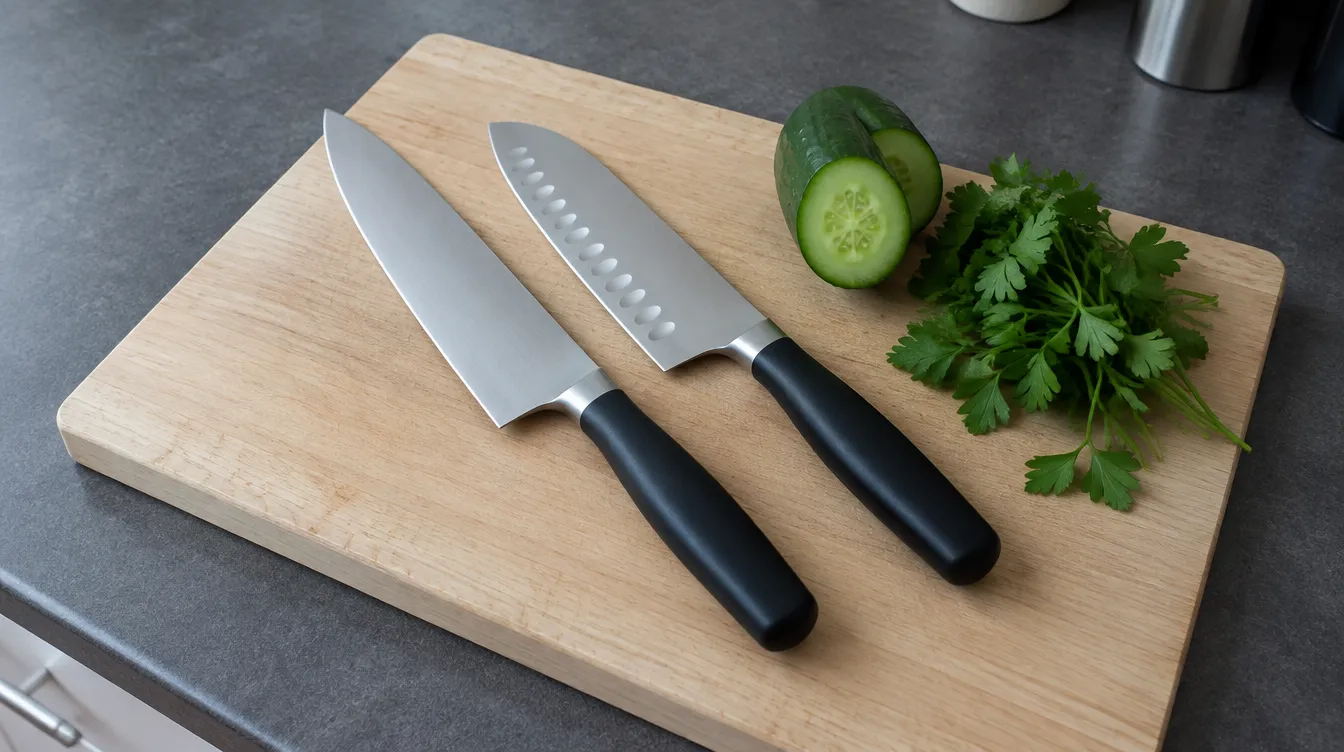
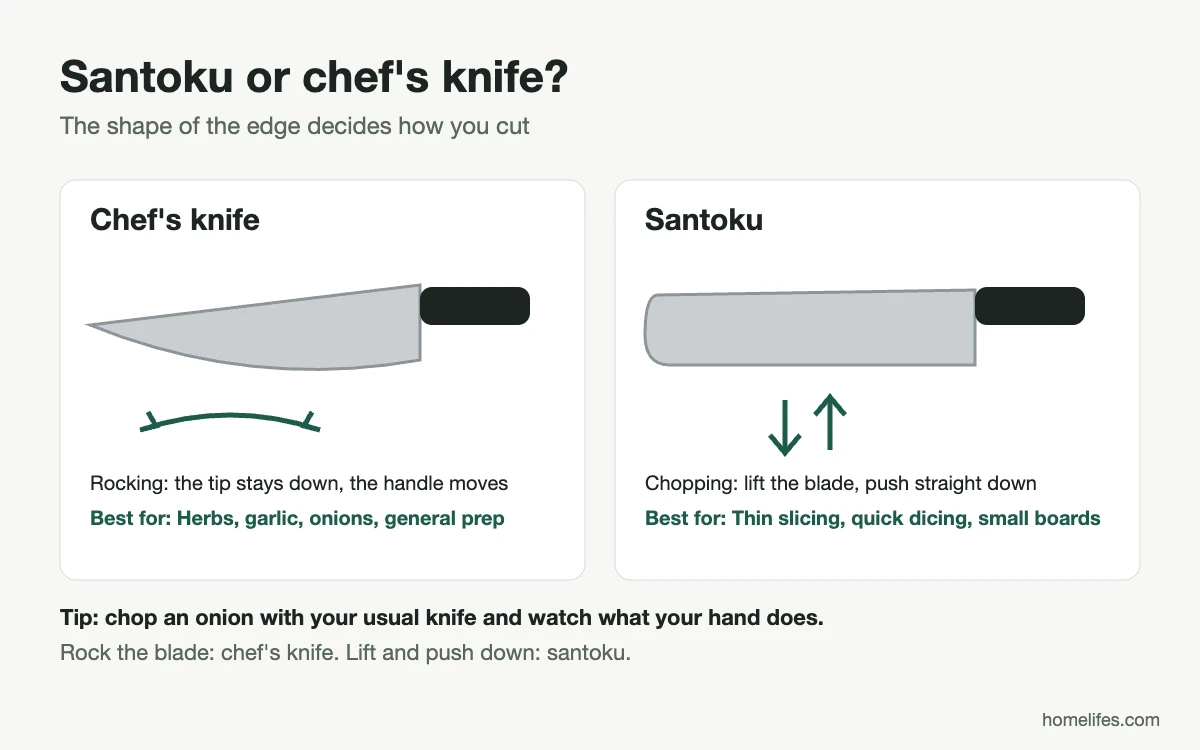
A chef’s knife has a curved edge that sweeps up to a pointed tip, and is usually 18 to 25cm long. The curve lets the blade rock on the board, which makes mincing herbs, garlic and onions quick.
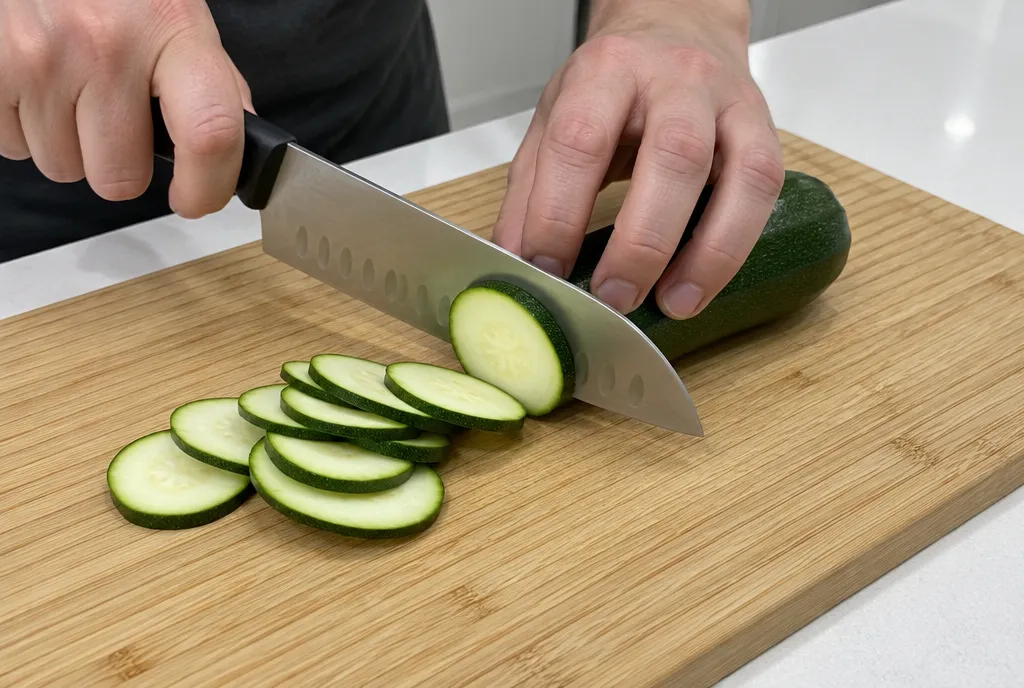
A santoku has a flatter edge and a rounded tip that drops towards the edge, and is usually shorter, around 16 to 18cm. The name is often translated as “three virtues”, meaning slicing, dicing and mincing. The flatter edge suits an up-and-down chopping motion, and the blade is often thinner. Some santokus have a row of shallow hollows along the side (a granton edge) meant to help slices fall away, though how much difference that makes varies between knives.
| Chef’s knife | Santoku | |
|---|---|---|
| Edge profile | Curved belly | Flatter edge |
| Tip | Pointed | Rounded, dropped |
| Typical length | 18 to 25cm | 16 to 18cm |
| Natural motion | Rocking | Chopping up and down |
| Best at | Herbs, garlic, onions, general prep | Thin slicing of vegetables, quick dicing |
| Trickier at | Close work in a tight space | Fine mincing with a rocking motion |
| Learning curve | A little technique for rocking | Easy to pick up |
The ten-second test
Take whichever knife you already own and chop an onion. Notice what your hand does.
- The blade tip stays on the board and the handle rises and falls? You rock. A chef’s knife will feel natural.
- You lift the whole blade and push it straight down? You chop. A santoku will feel natural.
- You have a small board or a compact kitchen? The shorter santoku is easier to manoeuvre.
- You have large hands or cook big quantities? The longer blade of a chef’s knife gives you more room.
Which jobs suit which knife
- Herbs, garlic, shallots: chef’s knife, thanks to the rocking motion.
- Cucumber, courgette, peppers, thin slices: santoku, because the flat edge cuts cleanly through in one go.
- Onions: either. It depends on your chopping style.
- Meat and fish: both can slice cooked meat and trim fish. Neither is a bone knife.
Sizing the knife to your board and hands
| Your board | Knife length that tends to work | Why |
|---|---|---|
| Under about 30cm long | 16 to 18cm (a santoku or a short chef’s knife) | The blade doesn’t overhang, so it’s easier to control |
| About 35 to 40cm long | 18 to 20cm | Room for a full, comfortable stroke |
| A large prep board | 20cm and up | Fewer strokes on big jobs |
These are rules of thumb. Comfort in your hand matters more than the number on the box.
Weight, balance and steel
Weight and balance matter more than the label. A blade-heavy knife tires the wrist, and a handle-heavy one feels clumsy on fine work. Hold the knife with a pinch grip just in front of the handle: it should feel stable and sit level.
On steel, harder steel generally holds an edge for longer but can chip if you twist it through hard food. Softer steel is more forgiving and easier to sharpen at home. Many Japanese-style santokus use thinner, harder blades, while European-style chef’s knives tend to be tougher, but there are plenty of exceptions, so check the maker’s description.
Three habits that blunt either knife
- Scraping food off the board with the sharp edge. Use the spine instead.
- Chopping on glass, stone or ceramic. Our guide to wood, bamboo or plastic chopping boards explains what is kind to an edge.
- Twisting or prying through hard food, and putting the knife in the dishwasher.
If you only buy one
For most kitchens, a chef’s knife of 18 to 20cm is the more flexible choice, and it’s the knife we put first in our guide to the kitchen knives you actually need. If your board is small, your hands are small, or you slice vegetables far more than you mince, a santoku is a perfectly good first knife.
Looking after either one
Both do best washed by hand and used on wood or bamboo. Thin blades can be more delicate, so avoid twisting them through hard food. Whichever you choose, keep it sharp. Our guide to sharpening at home covers honing and sharpening, and if you also slice bread, here’s why a bread knife tears instead of slicing.
Knives and a board to consider
The alternative
Victorinox Swiss Classic santoku (17cm)
Good for: fast, clean vegetable slicing, and kitchens with a small board.
Not ideal if: you mince lots of herbs with a rocking motion.
Paid link
The board
Large bamboo chopping board (40 × 30cm)
Good for: a surface that is kinder to edges than glass or stone, with room for a whole onion and the pile that follows.
Not ideal if: you already have a wooden board in good shape.
Paid link
Santoku and chef’s knife: common questions
Can a santoku replace a chef's knife?
For many people, yes. It handles most everyday prep. You’ll notice the difference mainly with fine mincing and when you want the long reach of a bigger blade.
Is a granton edge worth paying for?
It’s a nice touch for slicing, but not a reason on its own to choose a knife. Blade shape, balance and comfort matter more.