Our pick
de Buyer Mineral B Element frying pan (24cm)
Why we picked it
- A classic carbon steel pan that heats quickly and cools quickly, so you control the browning
- Takes metal tools, and improves with use instead of wearing out
- Light enough to flip and toss, unlike most cast iron
Worth knowing
- It needs seasoning before first use and hand-washing afterwards
- Check the handle on the model you buy before deciding whether it can go in the oven
Paid link
The first egg in a new carbon steel pan sticks. The second mostly slides. By the tenth, the base has darkened and the pan is doing what a non-stick coating promised and never quite delivered: lasting. That change is seasoning, and it’s why professional kitchens lean on carbon steel.
It’s also the part that puts people off. It sounds like a ritual. It isn’t. It’s about ten minutes on the hob, then a little patience over the next few weeks.
What seasoning actually is
Carbon steel is an iron alloy, so like cast iron it rusts if it’s left bare and wet. Seasoning is a thin layer of oil that has been heated until it bonds to the metal and hardens. It does two jobs: it keeps air and water off the steel, and it gives food a smooth, slippery surface. Every time you cook with a little fat, you add to it.
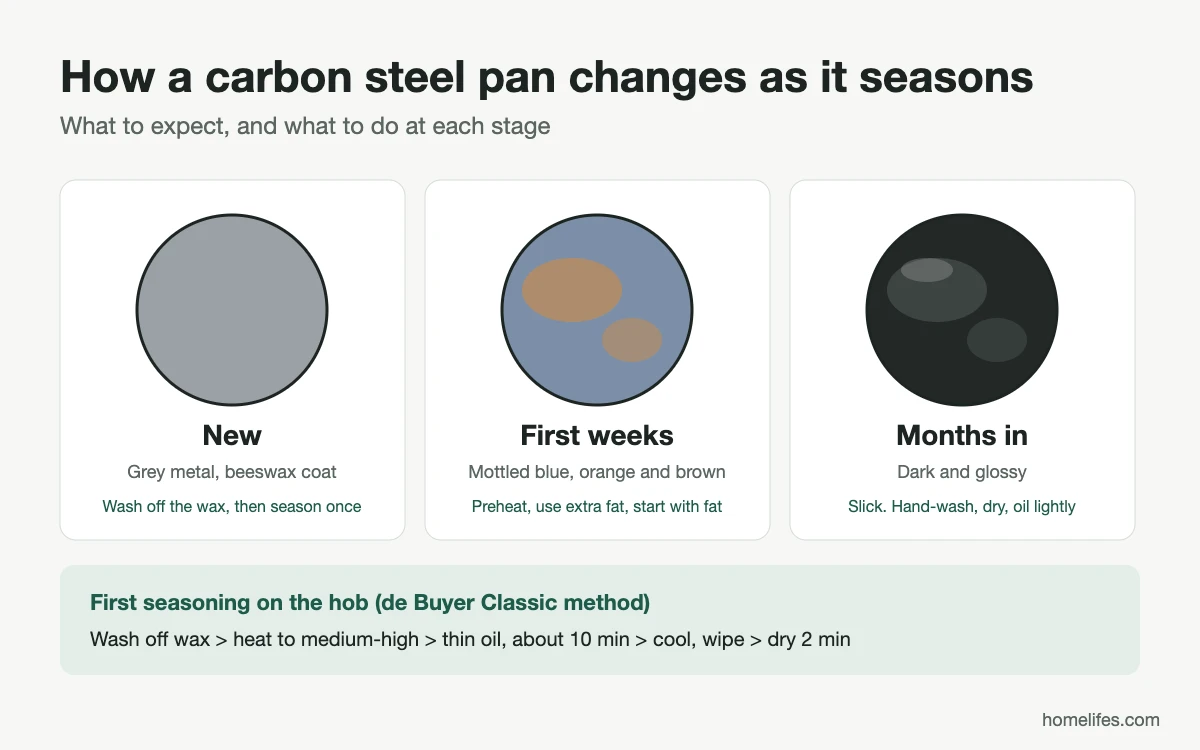
Many new pans arrive with a protective beeswax coating, as de Buyer’s Mineral B range does. That coating is only there for transit and storage, and it comes off in the first wash.
Carbon steel, cast iron and non-stick compared
| Carbon steel | Cast iron | Non-stick | |
|---|---|---|---|
| Weight | Lighter than cast iron | Heavy | Light |
| Heat response | Heats and cools quickly | Slow to heat, holds heat well | Quick |
| Searing | Excellent | Excellent | Limited |
| Upkeep | Season, hand-wash, dry | Season, hand-wash, dry | Gentle tools, replace when worn |
| Metal tools | Fine | Fine | No |
| Lifespan | Years to decades with care | Years to decades with care | A few years |
If you already own cast iron, the habits are the same. Our guide to why cast iron pans rust and how to stop it applies here too.
Seasoning a new pan, step by step
Methods differ between makers, so read your pan’s instructions first. These steps follow de Buyer, one of the best-known names in carbon steel.
The stovetop method
de Buyer says its Mineral B Classic pan should be seasoned on the stovetop only. The steps:
- Wash the pan in hot, soapy water to remove the beeswax, then dry it completely.
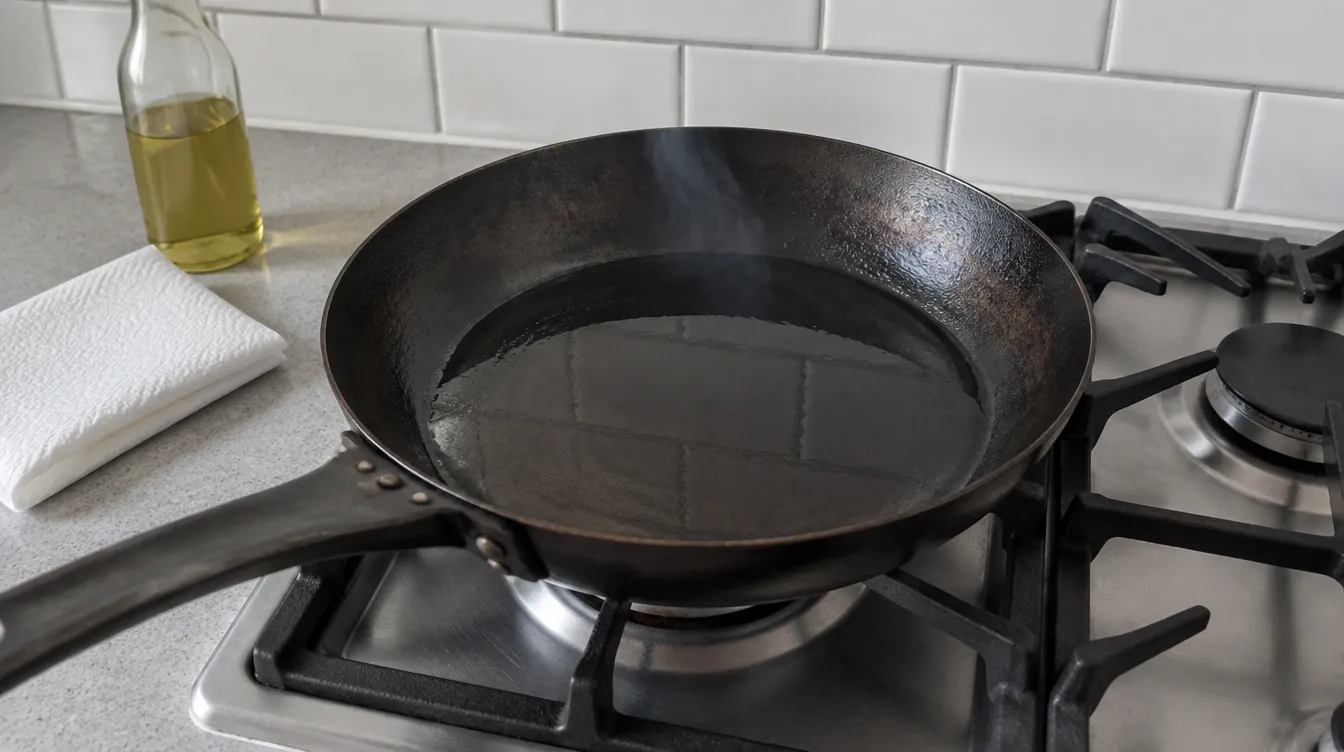
- Heat it over a medium-high heat, about three quarters of full power, until the surface is hot all over.
- Add a small amount of high smoke point oil, such as grapeseed, avocado, rapeseed or sunflower, and spread it over the whole surface, sides included.
- Let it heat for about ten minutes. It will smoke, so open a window and switch on the extractor.
- Turn off the heat and let the pan cool. Pour away any excess oil and wipe the pan with kitchen roll.
- Heat it dry for about two minutes to finish.
The oven method
Pans with oven-safe handles, such as de Buyer’s Mineral B Pro, can be seasoned in the oven. de Buyer’s oven method is:
- Wash and dry the pan completely.
- Rub a very thin, even layer of oil over the whole pan, inside, outside and underneath. Excess oil causes sticky patches instead of a smooth finish.
- Bake it upside down on the oven rack for one hour, at the temperature in your pan’s instructions.
- Switch off the oven and let the pan cool completely before you handle it.
- Repeat three or four times for a stronger layer.
Whichever method you use, keep the oil thin. A thick layer doesn’t season better. It turns tacky.
The first few weeks of cooking
- Preheat fully and coat the pan evenly in fat before the food goes in. A fresh pan forgives much less than an established one.
- Start with fatty foods such as bacon, sausages and shallow-fried potatoes, which tend to build seasoning as you cook.
- Go easy on acid. Long tomato sauces and wine reductions can strip a young surface, so save them until the pan has darkened.
- Leave eggs for a few weeks, then try one. The difference is a good measure of progress.
Cleaning and storing it
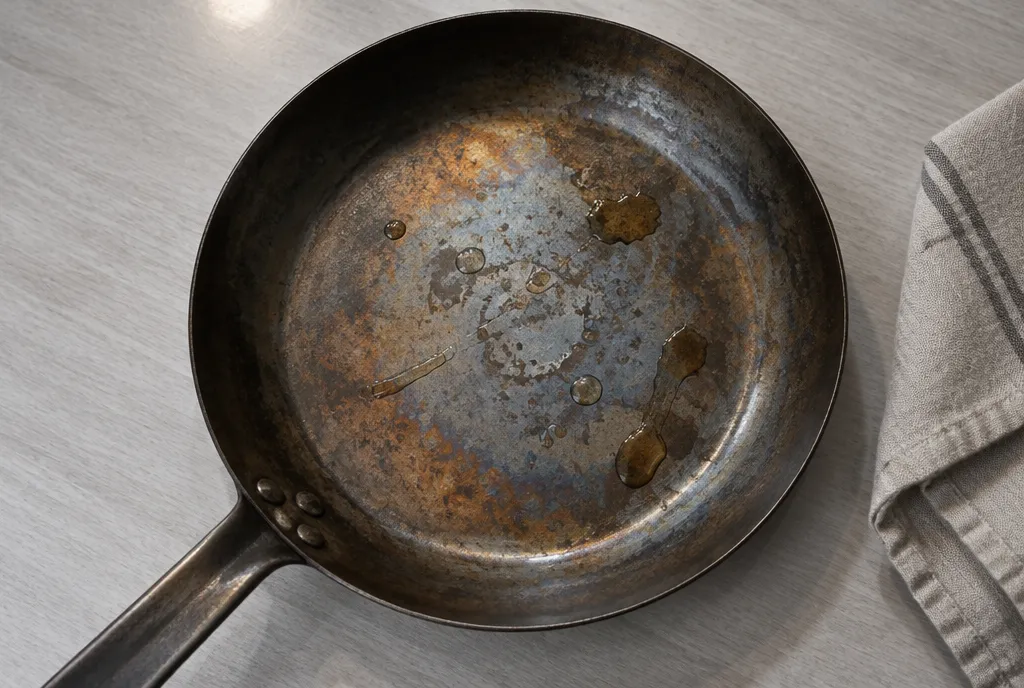
- Wash by hand with hot water and a soft brush or sponge. Avoid soaking and the dishwasher.
- For stuck-on bits, scrub with coarse salt moistened with a little oil. Retailers of de Buyer pans suggest this, because it cleans and reseasons in one go.
- Dry it straight away, ideally for a minute on a warm hob.
- Wipe a thin film of neutral oil over it for storage. Once the patina is established you can usually skip this.
When things go wrong
| Problem | Likely cause | What to do |
|---|---|---|
| Sticky or tacky patches | The oil layer was too thick | Scrub it back and re-season in thinner layers |
| Black flakes coming off | Layers built up too thickly or didn’t bond | Scrub the flaking areas back and re-season thinly |
| Orange spots | Rust from moisture | Scour them off, rinse, dry on the hob and re-season |
| Patchy colour | Normal while it builds | Nothing. It evens out with use |
| Food still sticks | Pan not hot enough, or too little fat | Preheat fully, add oil, and wait for it to shimmer |
Is carbon steel right for you?
Choose it if you want a pan for searing, omelettes and stir-fries that can last for years and take metal tools. Think twice if you want zero upkeep, simmer acidic sauces for hours, or put every pan in the dishwasher. Stainless steel is easier going, and our guide to why food sticks to stainless steel pans explains how to use it. If you’re replacing a worn coating, read why your non-stick pan stopped being non-stick.
Pans to consider
Oven-safe handle
de Buyer Mineral B Pro frying pan (24cm)
Good for: the Pro line, which de Buyer describes as having an oven-safe handle, so you can use the oven seasoning method.
Not ideal if: you only want a simple stovetop pan. Check the listing for handle details and size.
Paid link
Carbon steel: common questions
Do I need to season a carbon steel pan before first use?
Yes. The protective beeswax coating needs washing off, and a first layer of seasoning gives the steel some protection and a head start on release.
Can I use soap on carbon steel?
Soap is used to remove the beeswax before the first seasoning. After that, hot water and a soft brush are usually enough, as long as you dry the pan straight away.
Does carbon steel work on induction?
Carbon steel is magnetic, so in principle yes. Check the specific pan’s listing and base size to be sure.