Our pick
Victorinox Swiss Classic bread knife (21cm)
Why we picked it
- Serrated edge that handles crusts and soft loaves
- From a maker known for practical, long-lasting kitchen tools
- Comfortable handle for daily slicing
Worth knowing
- 21cm is short for very large bakery loaves; see the 26cm option below
- Keep it out of the dishwasher
Paid link
You’ve bought a good sourdough. The crust crackles, the crumb is soft, and the first slice comes off squashed at the top and ragged at the bottom. The knife feels sharp enough. So what’s going on?
Three checks before you blame the knife
- Is the blade longer than the loaf is wide? If not, you can’t make a full stroke, so you end up pressing down to finish the cut. Pressing is what squashes the crumb.
- Are you sawing or pushing? Long, light strokes with almost no downward pressure. Let the teeth do the work.
- Is the bread still warm? Fresh bread tears easily until it has cooled all the way through. Give it at least an hour.
If all three are fine and it still tears, then it’s time to look at the knife.
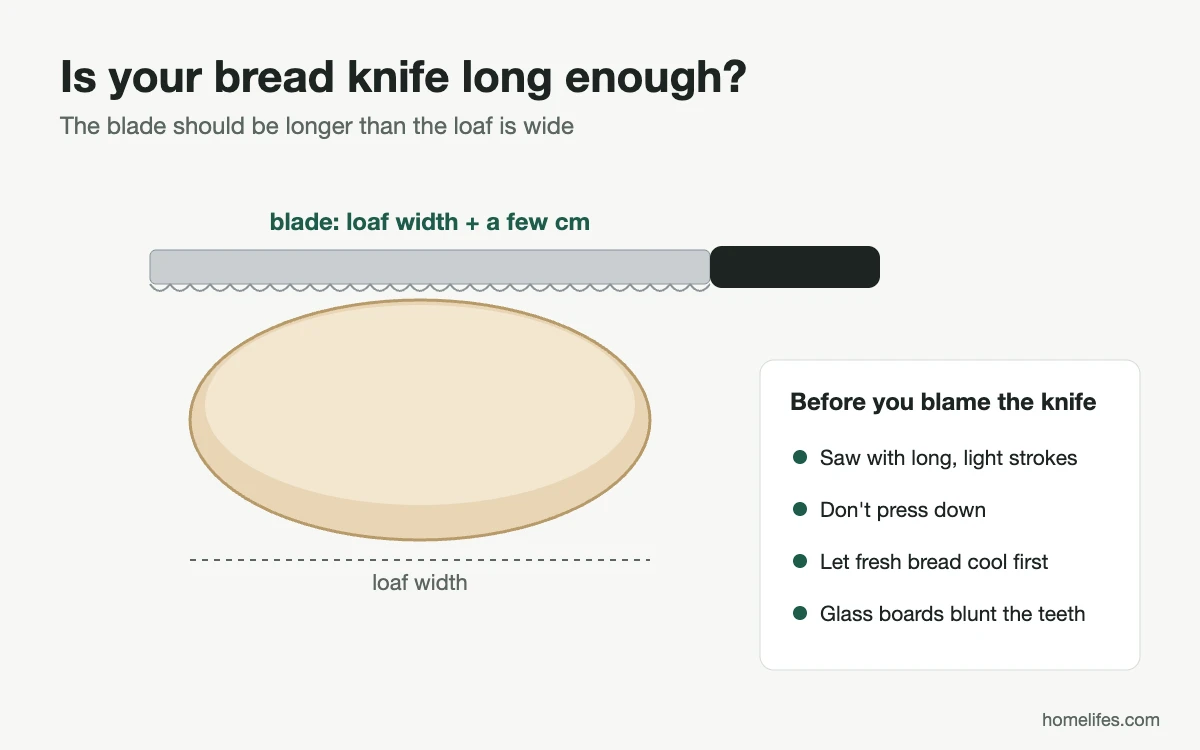
What the teeth are doing
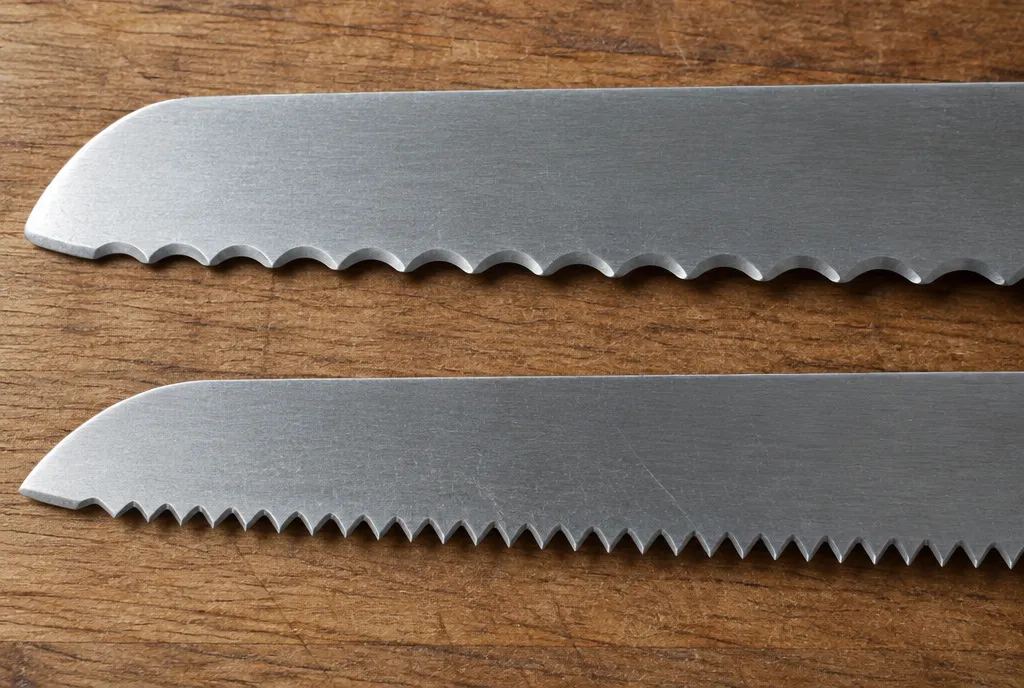
A bread knife is a fine saw. The points bite into a hard crust that a straight edge would skate across, and the gaps between them carry the cut forward without crushing what’s underneath. That only works while the blade is moving back and forth.
| Edge type | Best for | Watch out for |
|---|---|---|
| Scalloped (rounded waves) | Soft sandwich loaves, brioche, cake | Can skid on very hard crusts |
| Pointed teeth | Crusty sourdough, baguettes | Can tear very soft bread |
| Fine, shallow serrations | Tomatoes, citrus, delicate cakes | Too fine for thick crusts |
Sawing, not pressing
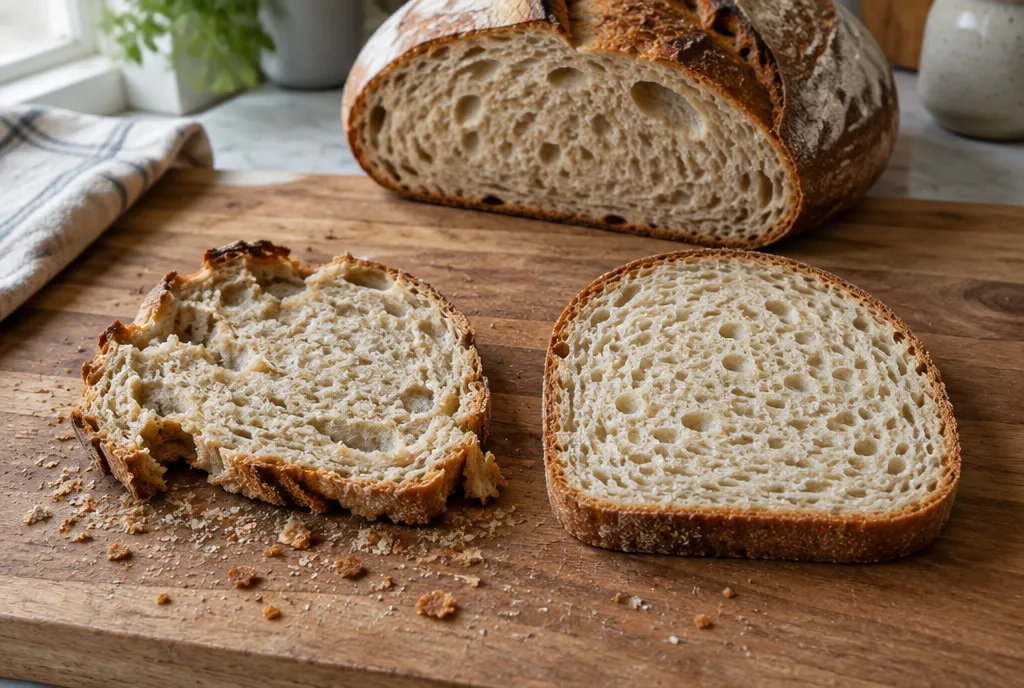
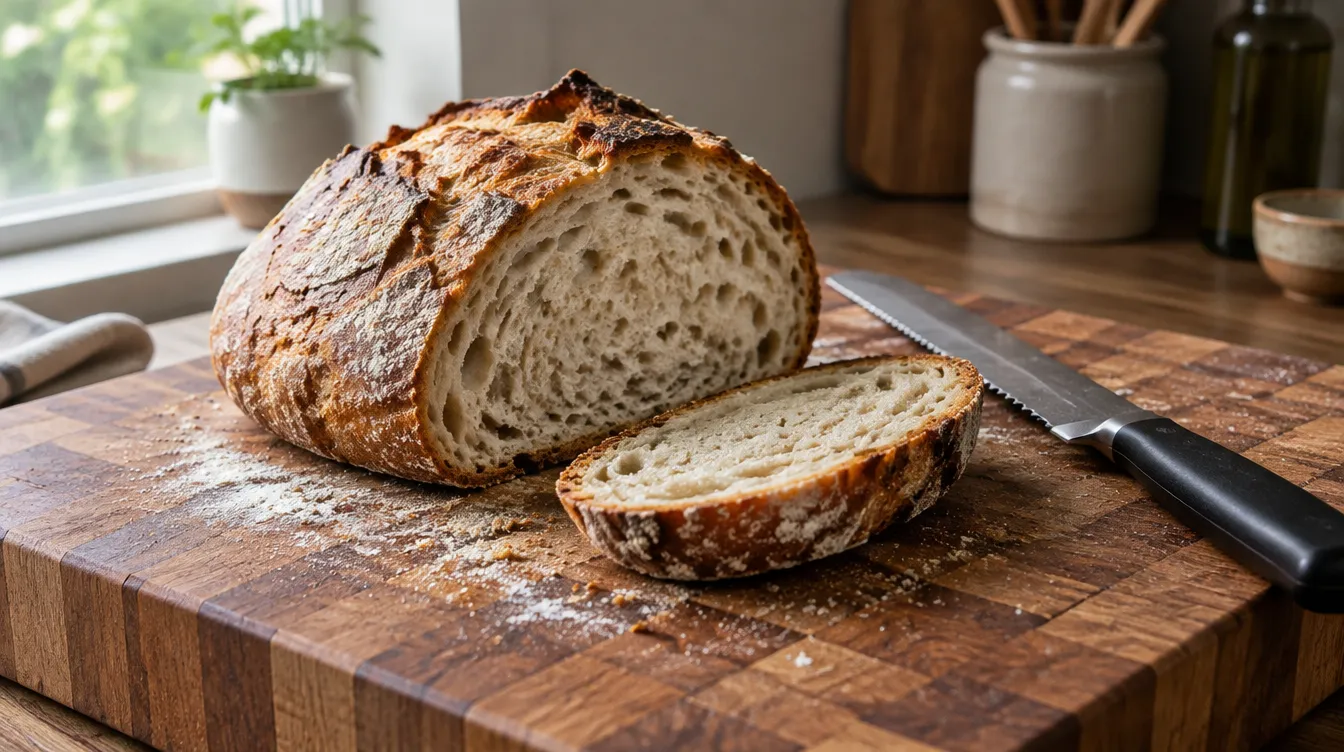
On a crusty loaf, start the cut on the top crust with the tip angled slightly down. Once you’re through the crust, keep the strokes long. If the bottom crust is very hard, turn the loaf on its side for the last few strokes. Those two slices above came from the same loaf; the only difference is technique.
Can it be sharpened?
Yes, but it’s fiddly. Serrated edges are sharpened one scallop at a time with a slim tapered rod, or by a professional service. Rounded, shiny points are the sign a knife has genuinely gone dull. For an inexpensive knife, replacing it is often simpler.
Different breads, different technique
- Crusty sourdough: start on the top crust with the tip angled slightly down, then saw through. For a very hard base, turn the loaf on its side for the last few strokes.
- Baguette: cut on a slight diagonal and hold it gently near the cut, not in the middle, or it will flatten.
- Soft sandwich loaf: let it cool completely, then lay it on its side so you’re cutting through the softest part first.
- Brioche and enriched breads: the lightest touch of all. Long strokes, almost no pressure, and a scalloped edge if you have one.
- Dense rye and seeded loaves: slice thinner than you think, and wipe the blade between slices so seeds don’t drag.
Keeping it sharp between uses
Serrated knives go dull mostly from contact with other metal, not from bread. Keep yours in a block, on a magnetic strip or in a blade guard rather than loose in a drawer. Cut on wood or bamboo, never on glass or stone. Wash it by hand and dry it straight away, which also stops the handle loosening over time.
A standard sharpening steel won’t reach into the serrations. If you want to maintain the edge yourself, it needs a slim tapered rod worked through each scallop. Most people find a professional sharpening service once every year or two easier.
Which knife for which loaf
Supermarket loaves and toast
The knife
Victorinox Swiss Classic bread knife (21cm)
Why we’d pick it: a well-regarded, affordable serrated knife from a maker known for practical kitchen tools. Comfortable for daily slicing.
Not for you if: you mostly buy big bakery loaves. A longer blade will serve you better.
Paid link
The board
Large bamboo chopping board (40×30cm)
Why we’d pick it: bamboo and wood are kinder to serrated edges than glass or stone, which blunt blades quickly.
Not for you if: you already have a wooden board in good shape.
Paid link
Big sourdough loaves
The knife
Victorinox Swiss Modern bread knife (26cm)
Why we’d pick it: the extra length gives you full strokes across wide loaves, which is exactly what stops the tearing.
Not for you if: your knife drawer can’t take a long blade.
Paid link
The storage
Brabantia roll top bread bin
Why we’d pick it: crusty bread dries out more slowly than on the worktop, so it still slices cleanly on day two.
Not for you if: you freeze most of your bread on day one.
Paid link
Hard crusts and baguettes
The knife
Mercer Culinary M23210 bread knife (10-inch)
Why we’d pick it: a long blade with a wide wavy edge that saws through hard crusts rather than crushing them.
Not for you if: you mostly cut soft sandwich bread. The Victorinox above is gentler.
Paid link
The storage
Organic linen bread bag (extra large)
Why we’d pick it: lets crusty bread breathe, so the crust stays crisp instead of going leathery in plastic.
Not for you if: bread lasts more than a couple of days in your house. Freeze it instead.
Paid link
Whichever you choose, keep serrated knives out of the dishwasher, where they rattle against the cutlery, and avoid glass boards altogether.
Keeping the loaf fresh is the other half of the problem: why your bread goes stale or mouldy so fast. For your straight-edged knives, see sharpening at home.
Wondering which other knives are worth owning? Read the kitchen knives you actually need.
Quick answers
Why does my bread squash when I cut it?
Usually too much downward pressure, a blade shorter than the loaf, or bread that’s still warm inside.
Do I need an offset bread knife?
It helps with tall loaves because your knuckles stay clear of the board, but it isn’t essential.
Next: why your non-stick pan stopped being non-stick.
Update, 2 October 2026: two knives we originally picked aren’t sold on Amazon UK, so we’ve replaced them with the Victorinox Swiss Modern 26cm and the Mercer M23210.